Modern Lighting Upgrades to Create a Warm and Beautiful Home Atmosphere!
Lighting changes a home faster than almost any other upgrade. The same room can feel cold and flat under a single harsh ceiling bulb, then warm and welcoming once light comes from several places at different heights. The secret is not buying more light, it is buying warmer light, layered properly, with control over brightness. This guide explains how to layer ambient, task, and accent lighting in every room, which bulbs and colour temperatures to choose, and which modern upgrades give the biggest atmosphere boost for the money.
Why Warm Light, Not More Light, Changes a Home’s Atmosphere
Warm light feels relaxing because it mimics the low, golden light of late afternoon and candlelight, while cool white light mimics midday sun and keeps the brain alert. That is why a living room lit with cool daylight bulbs can feel like an office no matter how beautiful the furniture is. Colour temperature is measured in Kelvin: warm white sits around 2700K to 3000K, neutral white around 4000K, and daylight at 5000K and above. For living areas, bedrooms, and dining rooms, warm white is almost always the right choice, while neutral white suits kitchens and study areas where you need to see detail clearly.
Brightness matters too, but it is not the whole story. A room with one very bright ceiling light and dark corners feels harsh, while a room with several softer lights at different heights feels calm and spacious. The goal is even, gentle illumination with pools of slightly brighter light where you actually do things: reading, cooking, or eating. Dimmers are the cheapest way to get this flexibility, because one dimmed light can serve ten moods, from bright family dinner to a quiet evening film.
Layered Lighting in the Living Room: Ambient, Task, and Accent
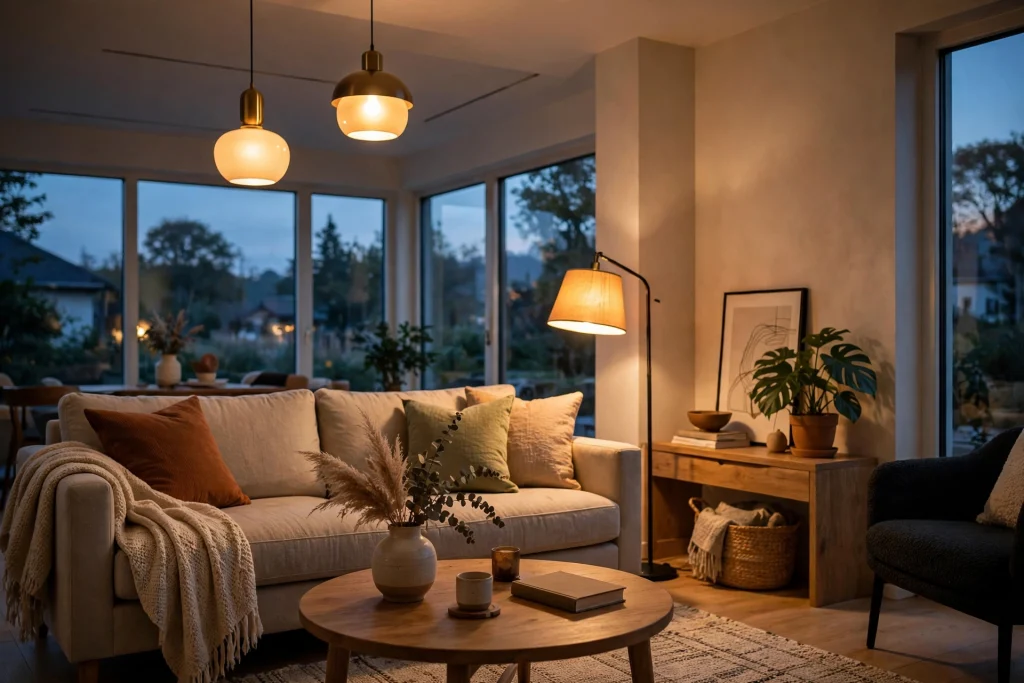
Professional designers never rely on a single light source. They build three layers. Ambient light is the general base: recessed downlights, a central pendant, or a chandelier on a dimmer. Task light is focused light for an activity, such as a floor lamp beside a reading chair or a table lamp on a sideboard. Accent light draws the eye to something beautiful: a picture light over art, a wall washer on a textured wall, or an LED strip behind a television unit. When all three layers are present, the room gains depth and the eye has somewhere pleasant to rest.
A practical living room plan starts with dimmable warm-white downlights or a central fixture, then adds two or three lamps at eye level. Table lamps on a console and an arc floor lamp beside the sofa create the soft downward glow that makes a large room feel intimate. For atmosphere, switch the main ceiling light off in the evening and let the lamps do the work; the difference is immediate. Add a statement pendant or a sculptural floor lamp as the room’s focal piece, and keep the rest of the fittings quiet so the focal piece can shine.
Kitchen Lighting Upgrades That Flatter Food and Faces
Kitchens need two kinds of light at once: bright, accurate light for chopping and cooking, and warm, flattering light for eating and gathering. The solution is to separate the circuits. Under-cabinet LED strips give shadow-free light across the worktop exactly where knives and food are, while pendants over the island or dining table provide a warm focal glow. Glass-fronted cabinets lit from within look beautiful at night, and a dimmer on the pendant circuit lets the same kitchen shift from cooking mode to dinner-party mode.
Choose bulbs carefully in the kitchen. A colour temperature around 3000K to 4000K works well for task areas, and a colour rendering index (CRI) of 90 or above makes food, skin, and wood tones look natural instead of washed out. Pendant height matters: hang pendants roughly 75 to 80 centimetres above an island or table so they light the surface without blocking sightlines across the room. Avoid a single central ceiling light as the only source, because it casts your own shadow onto the worktop whenever you stand at the counter.
Bedroom Lighting That Helps You Wind Down at Night
Bedrooms should wind you down, so the lighting plan is deliberately gentle. A dimmable overhead light on a low setting, wall lights on either side of the bed, and a bedside lamp for reading give you three levels of brightness to choose from as the evening progresses. Warm white bulbs at 2700K are ideal here, because cool light late at night can make it harder to relax. Wall sconces flanking the bed free up bedside table space and create a soft, symmetrical glow that suits a calm room.
Small details make a big difference in the bedroom. A light with a fabric or frosted shade diffuses the glow and avoids glare when you are lying down. If you read in bed, a swing-arm sconce lets you direct light onto the page without waking a partner. Consider a low-level light on the route to the bathroom, so you never need the bright overhead light in the middle of the night.
Bathroom Lighting That Is Flattering and Safe Around Water
Bathroom lighting fails most often when a single overhead light casts shadows on the face, which makes shaving and applying makeup harder and less flattering. The fix is light from the sides: wall sconces or a slim vertical bar on either side of the mirror at face height give even, shadow-free illumination. A dimmable overhead light provides general brightness for cleaning and bathing, while the mirror lights handle the close work. A colour temperature of 3000K to 4000K gives a natural, true-to-life reflection.
Safety is not optional in a bathroom, because water and electricity are a dangerous combination. Only use fittings rated for bathroom zones, such as IP44 or higher near showers and baths, and never install a standard pendant or table lamp where it can be splashed. Any new bathroom circuit, extractor fan with a light, or heated mirror should be installed by a licensed electrician, who will confirm the correct zones and protection. LED mirrors with built-in demisters are a popular modern upgrade: they stay clear after a hot shower and combine mirror, light, and storage in one fitting.
Hallway, Stair, and Entry Lighting That Guides Guests In
Hallways and stairs are the first spaces guests see, yet they are often lit with a single bare bulb. A warm wall light or small pendant in the entry, a mirror that bounces light around, and low-level step lights on stairs make the whole home feel welcoming and safer underfoot. Motion sensors are a smart upgrade here, switching lights on only when someone is there.
Choosing Bulbs, Dimmers, and Smart Controls for a Warm Glow
Modern LED bulbs are the sensible default: they use far less power than old incandescent bulbs and last for tens of thousands of hours. When buying, look beyond wattage and check three numbers on the box: colour temperature in Kelvin, lumens for brightness, and CRI for colour quality. A CRI of 90 or above is worth seeking out, because low-CRI bulbs make wood, food, and skin look dull. For living areas choose 2700K to 3000K; for kitchens and desks, 4000K is a good compromise.
Dimmers turn one light into many, but they must match the bulb: older dimmer switches can flicker or buzz with LED bulbs, so fit LED-compatible dimmers and check the bulb packaging for dimmable labelling. Smart bulbs and smart switches add another layer of control, letting you set scenes such as dinner, reading, or movie night from a phone or voice assistant.
Lighting Mistakes That Make a Warm Home Feel Cold and Flat
The most common lighting mistake is using daylight bulbs of 6000K or above in relaxation areas. They make white walls look blue, wood look grey, and people look tired. Reserve cool white for utility rooms, garages, and desks, and keep living areas warm. A second mistake is relying on a single overhead light in every room, which creates harsh shadows and a flat feeling. Every room needs at least two light sources at different heights before it starts to feel designed.
Other mistakes are easy to fix once you see them. Bare bulbs with no shade glare into the eyes and should always be covered with a diffuser, shade, or frosted glass. Pendants hung too high lose their intimacy, while pendants hung too low block conversation across a table. Mixing colour temperatures in one room, such as a warm lamp beside a cool ceiling light, creates a clash that the eye notices even if the brain cannot name it. Finally, forgetting dimmers is a missed opportunity: without them, every evening is lit at full brightness, and the home never gets its quiet, low-light mood.
When Lighting Work Needs a Licensed Electrician
Swapping a bulb, fitting a plug-in lamp, or sticking on a battery-powered LED strip is safe do-it-yourself work. The line is crossed as soon as wiring is involved: installing a new ceiling fitting, adding a circuit, or fitting a dimmer switch all need a licensed electrician in most areas, and bathroom and kitchen circuits are especially regulated. Never work inside a consumer unit or fuse box yourself.
Before hiring, get a written quote that lists the fittings, the labour, and any making-good work such as plastering after chasing cables. Ask for proof of licensing and insurance, and check that the electrician will certify the work where required. If your home has old wiring, aluminium conductors, or no earth connection on lighting circuits, mention it upfront, because the electrician may need to upgrade part of the circuit before new fittings can be installed safely. Good lighting is worth doing properly, because badly wired lighting is a fire risk that no atmosphere is worth.
Final Thoughts: A Warmer, More Beautiful Home, One Layer at a Time
A warm, beautiful home is not created by one expensive chandelier. It comes from layering warm light at different heights, choosing bulbs with the right colour temperature and colour quality, and giving yourself control with dimmers. Start with the room you spend your evenings in: swap the bulbs to warm white, add a lamp at eye level, and fit a dimmer. The change is immediate and the cost is small.
Warm Home Lighting FAQs
What colour temperature makes a home feel warm?
Warm white bulbs at 2700K to 3000K create the cosy, golden glow most people associate with a welcoming home. Neutral white at 4000K suits kitchens and study areas, while daylight bulbs at 5000K and above feel cold in living areas and are best reserved for utility spaces and desks.
How many light sources does a living room need?
Aim for at least three: an ambient source such as a dimmable ceiling light, a task source such as a floor or table lamp, and an accent source such as a picture light or LED strip. Three sources at different heights give the room depth and let you change the mood by switching layers on and off.
Are LED bulbs really better than old bulbs for atmosphere?
Yes, provided you choose the right ones. Look for warm white colour temperature, a CRI of 90 or above, and dimmable labelling if you use a dimmer. Modern LEDs use far less power and last far longer than incandescent bulbs, and warm-white LEDs now produce a glow that is very close to the old-fashioned warm light people love.
Where should pendant lights hang over a dining table?
A good starting point is 75 to 80 centimetres above the table surface, which lights the table well without blocking sightlines across it. In rooms with very high ceilings, hang them slightly lower for intimacy, and always use a dimmer so the same pendant can serve bright family meals and soft evening dinners.
Can I install dimmer switches myself?
Fitting a dimmer involves mains wiring, so in most areas it should be done by a licensed electrician. The electrician can also confirm the dimmer is LED-compatible, because an old dimmer can make LED bulbs flicker or buzz. Swapping bulbs and adding plug-in lamps are safe DIY jobs; anything involving the fixed wiring is not.
What is the cheapest lighting upgrade with the biggest impact?
Swapping every bulb in your main living areas to warm white 2700K LEDs is the cheapest high-impact change, and it can be done in an afternoon. The next best step is adding one good floor or table lamp at eye level and a dimmer on the main light, which together transform the evening atmosphere for a modest cost.