Retaining Wall Finishes for Contemporary Residential Landscapes With Challenging Elevation Changes
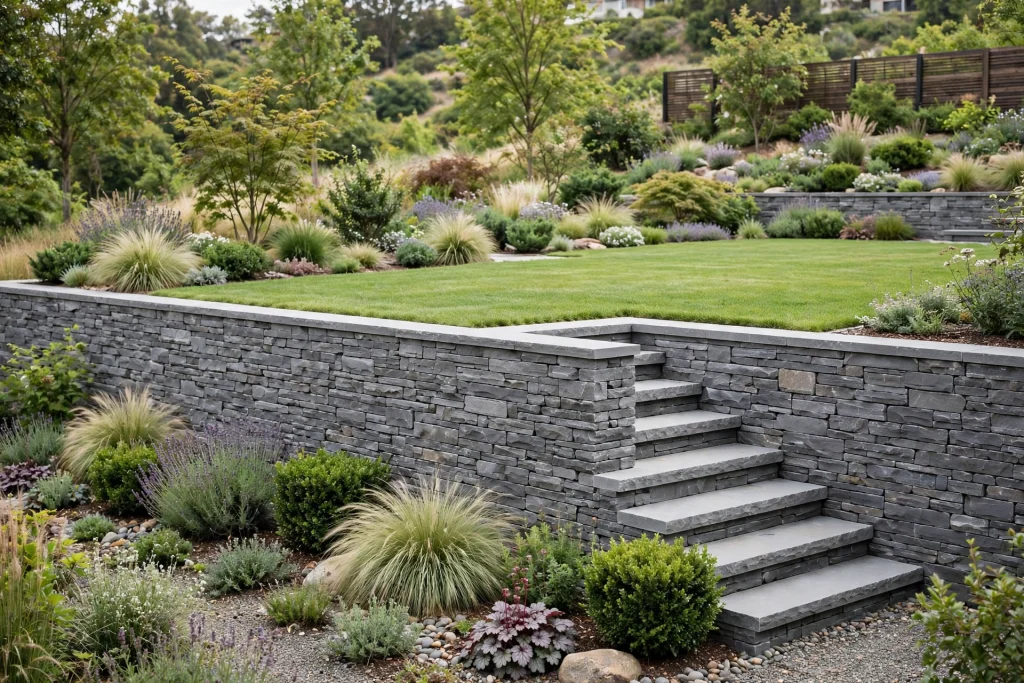
A steep backyard is both a design opportunity and an engineering problem, and the finish on your retaining wall decides which one visitors notice. Retaining wall finishes are the visible surface treatments applied to the wall face, and on sites with challenging elevation changes they must do two jobs at once: look intentional and contemporary while tolerating drainage, soil pressure, and weather exposure. The right finish turns a necessary structure into a landscape feature; the wrong one traps moisture, peels, or cracks within a few seasons.
The Short Answer: Choosing Retaining Wall Finishes for Sloped Sites
Match the finish to the wall type, not just the look you want. A poured concrete or concrete-block core accepts almost any finish, including stucco, stone veneer, paint, and textured overlays, while segmental block walls look best with their factory face or a complementary cap. On slopes, avoid finishes that trap water behind them, always budget for drainage alongside the finish, and reserve premium veneers for walls people actually see up close. For most contemporary landscapes, large-format stone veneer, smooth render, or board-formed concrete deliver the modern look with the fewest maintenance headaches.
Why Elevation Changes Dictate Finish Choices
Retaining wall finishes on flat ground are mostly about taste. On a slope, gravity and water have a vote. Water draining off the slope above collects behind the wall, and hydrostatic pressure can push finishes off the face if the wall cannot drain freely. This is why drainage design (gravel backfill, perforated pipe, weep holes) must be planned with the finish, not after it.
- Tiered walls: on steep sites, two or three low walls often replace one tall one. Finishes repeat across tiers for cohesion, or the main terrace wall gets the premium finish while upper walls use the simpler treatment.
- Step-downs: walls that step down with the base elevation need corner and end detailing; half-height block courses and matching cap units keep transitions smooth.
- Tall single walls: walls above roughly 4 feet typically need engineered design. Heavy veneers add weight the design must account for, so confirm the finish with your engineer before specifying.
- Surcharges: walls supporting patios, pools, driveways, or outdoor kitchens carry extra loads; choose finishes that do not compromise the structural core or block required drainage paths.
Built-In Finishes: When the Wall Face Is the Finish
Segmental Retaining Wall Blocks (SRWs)
Interlocking concrete blocks (systems such as Allan Block, Versa-Lok, and Keystone) come with split-face, tumbled, or smooth factory finishes in many colors. They are the most DIY-friendly option for walls under 3 to 4 feet and look deliberately modern when the color palette is restrained. Their honest, modular look suits contemporary landscapes; mismatched color or an un-capped top edge is what makes them look cheap.
Gabion Baskets
Wire cages filled with stone are genuinely structural and need no extra finish. They read industrial-contemporary, handle drainage beautifully because water passes through, and need no concrete footing. Cost estimates run roughly $10 to $55 per square foot of wall face installed, depending on stone and basket quality.
Dry-Stack Natural Stone and Boulder Walls
Fieldstone, limestone, and bluestone walls have genuine character and age well, developing patina rather than deteriorating. Every stone is different, so labor is the cost driver: natural stone walls typically run $15 to $95 per square foot installed. Boulder walls ($15 to $30 per square foot installed) suit rural or woodland properties but need heavy equipment, so they are not DIY.
Timber Walls
Pressure-treated timber is the most affordable structural option ($15 to $30 per square foot installed) but the shortest-lived, typically 10 to 20 years in soil contact. It suits rustic or cottage schemes better than contemporary ones, and creosote-treated railroad ties should be avoided near planting beds.
Surface Finishes for Concrete and Masonry Walls
A poured concrete or concrete-block wall is a blank canvas. These surface finishes apply over a sound, clean substrate and let you set the exact tone of the landscape.
Stucco and Parging
Traditional three-coat stucco (scratch, brown, and finish coats over lath, about 7/8 inch thick) is durable and fire-resistant; one-coat systems are thinner and faster but more damage-prone. A simpler parge coat — a thin troweled layer of mortar — smooths blockwork into a clean, uniform face. Both take color well and suit crisp contemporary geometry. Allow full cure times between coats before painting or sealing.
Masonry Paint and Concrete Stain
Masonry paint gives breathability, mold resistance, and bold color choice; elastomeric paints go further, bridging hairline cracks and resisting moisture. Concrete stain is semi-transparent, enhancing the wall's natural texture rather than hiding it. Two coats and a clear sealer extend life; expect to repaint every 5 to 10 years in exposed locations.
Textured Overlays and Stamped Concrete
Thin cementitious overlays add sand, dash, or smooth texture without stucco's thickness. Stamped or formed-in patterns imitate stone or brick while the concrete is wet; a stain afterward sells the realism. Decorative stamped finishes typically add $5 to $15 per square foot to the project cost (estimates).
Board-Formed Concrete
The architect's favorite: concrete cast against timber boards, left exposed. The wood grain imprint gives massive walls a warm, crafted feel that pairs beautifully with modern landscaping. It costs more because the formwork is the finish, but nothing else looks quite like it.
Cladding and Veneer Options
Natural and Manufactured Stone Veneer
Thin stone slices, real or molded concrete, adhere directly to the wall with mortar. They deliver the full-stone look at a fraction of the weight and cost: veneer typically adds $5 to $25 per square foot (estimates). Corner pieces, set first with alternating long and short ends, make edges look convincing.
Brick Slips and Tile Panels
Thin brick slips give a loft-like warmth; large-format porcelain panels are the boldest contemporary choice, reading almost like architecture. Both need a flat, stable substrate and exterior-rated adhesive.
Metal and Timber Cladding
Cor-Ten steel, powder-coated aluminum, or hardwood slats mounted on battens over the wall create striking modern facades. Keep cladding off the ground, allow ventilation behind it, and never use soil-contact timber for the battens.
Living Finishes: Letting Plants Do the Work
Cascading plants, trained vines, and terraced planting beds soften hard walls better than any coating. A planting bed at least 18 inches deep at the base, plus pocket planters or integrated wall planters at the top, integrate the wall into the landscape. Green finishes cost little beyond plants and irrigation but need ongoing care, and aggressive root systems should stay away from drainage layers.
Detail Finishes That Define a Contemporary Look
Coping and caps: a clean limestone, bluestone, or precast cap unifies the top edge and sheds water. Budget roughly $5 to $15 per cap piece (estimates).
Lighting: low-voltage LED strip or step lights set into the wall turn structure into atmosphere at night and mark level changes safely.
Weep holes and drains: never seal or cover drainage outlets with a finish. Weeps should stay visible and functional; dress them with discreet grates if needed.
Consistent palette: limit the wall to two materials — one primary finish plus coping or one accent band. Contemporary design is about restraint.
Comparing Retaining Wall Finishes
Cost Guide: Retaining Wall Finishes (Estimates)
Finish costs sit on top of the wall's structural cost. All figures below are rough installed-cost estimates per square foot of wall face and vary widely by region, access, and wall height; sloped sites with poor access can run 15 to 50 percent higher.
Common Mistakes to Avoid
- Finishing before the wall is structurally complete and drained — trapped water blisters paint and pops veneer.
- Covering weep holes or drainage outlets with stucco, paint, or cladding.
- Choosing a finish the wall type cannot accept, such as heavy stone veneer on a wall not designed for the extra weight.
- Skipping surface prep: veneer and stucco need a clean, sound, properly primed substrate with a bonding agent where specified.
- Mixing too many materials — three or more finishes on one wall reads chaotic, not curated.
- Forgetting the top: an uncapped wall edge ruins even the best face finish and invites water in.
- Ignoring access: delivering stone or running equipment across a steep, tight site inflates labor cost dramatically.
Safety and When to Call a Professional
Retaining walls are structural. Walls over 4 feet tall, walls supporting driveways, buildings, or pools, and walls on steep or unstable slopes should be designed or reviewed by a structural engineer and built by an experienced contractor; permits and inspections are commonly required at these heights. Never excavate near utilities without locating them first, and never let DIY enthusiasm override drainage design — most wall failures trace back to water, not to the finish. For finishes specifically, hire a professional for three-coat stucco, natural stone veneer on tall walls, any work involving scaffolding or heavy stone, and electrical work for integrated lighting. A mason or landscape contractor can also confirm your chosen finish is compatible with the wall's drainage system before you commit.
Final Thoughts
The best retaining wall finish for a sloped contemporary landscape is the one that respects both the engineering and the eye: pick a finish suited to your wall's structure and drainage, keep the palette to two materials, and spend the premium dollars where people actually look. Your next step is simple — walk your slope, photograph the walls from the patio and entry, and shortlist two finishes that fit both the structure and the view. Then get itemized quotes that separate the wall build, drainage, and finish so you can compare like with like.
Frequently Asked Questions
What is the cheapest way to finish a concrete retaining wall?
Concrete stain or masonry paint is the cheapest route, typically $1 to $6 per square foot installed as estimates. Clean the wall thoroughly, repair cracks with patching compound, apply two coats, and seal. It is a cosmetic finish, not a structural one, so it works best on sound, stable walls.
Can you put stone veneer on an existing retaining wall?
Yes, provided the wall is structurally sound, plumb, and clean. Thin veneer (3/4 to 1.5 inches) bonds with mortar to concrete or block without a structural ledge, but the substrate must be properly prepared and drainage must remain functional. Have a mason assess older walls before committing.
How do you finish a retaining wall on a steep slope?
Break the elevation into tiers of lower walls rather than one tall face, use step-downs where the base elevation changes, and repeat one finish across tiers for cohesion. Budget extra for drainage and access, since steep sites raise labor costs, and keep heavy veneers for the most visible tier.
Does painting a retaining wall trap moisture?
Standard exterior paint can trap moisture if the wall cannot dry to the front, so use breathable masonry paint and never paint over active leaks or efflorescence without fixing the water source. Elastomeric coatings resist moisture better, but no coating substitutes for proper drainage behind the wall.
What finish lasts longest on a retaining wall?
Structural faces — dry-stack natural stone, gabion, and quality segmental block — last decades with minimal care because the finish is the structure. Among applied finishes, three-coat stucco and natural stone veneer are the most durable; paints and stains need recoating every 5 to 10 years.
Should retaining wall finishes match the house?
They should complement, not clone. Pull one material or color from the house — the coping stone, a trim color, the paving — and let the wall have its own quieter voice. Identical materials on every surface tend to look flat; contrast with restraint looks designed.
Do I need a permit to refinish a retaining wall?
Cosmetic refinishing alone rarely needs a permit, but any structural alteration, height increase, or wall over the local height threshold (commonly 4 feet) usually does. Check with your local building authority before rebuilding or extending a wall, even if the finish is the main goal.